
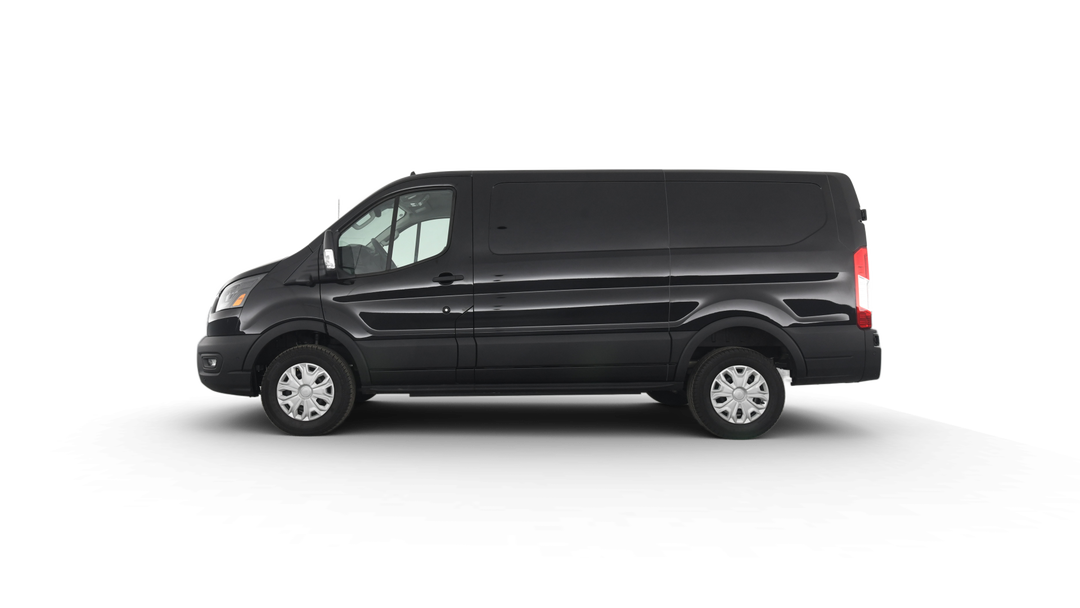
Ford E-Transit 350 Low Roof, Medium Roof & More

Last updated August 4, 2026

Ford E-Transit 350 Cargo Van

The Ford E-Transit 350 Cargo Van lineup is organized by roof height and body length, not comfort or luxury. Low Roof is the garage-friendly urban van; Medium Roof is the versatile middle ground; High Roof adds standing-height cargo room without the longest body; and Extended High pairs that tall roof with the extended body for maximum enclosed space.

What each trim is known for

Ford E-Transit 350 Cargo Van Low Roof

Low Roof

Low RoofLow Roof w/LWBLow Roof w/RWB

The Low Roof trim level includes Low Roof, Low Roof w/LWB, and Low Roof w/RWB; it is the clearance-friendly E-Transit for garages, loading areas, and tighter city routes.

Best for: Urban delivery and service operators who value easier access under height limits more than standing-height cargo room.


Highlights

  • Lowest roof profile in the lineup
  • Regular- and long-wheelbase body formats
  • 57-inch cargo height on the long-body version
  • 180-degree rear cargo doors
0 in stock
Ford E-Transit 350 Cargo Van Medium Roof

Medium Roof

Medium RoofMedium Roof w/LWBMedium Roof w/RWB

The Medium Roof trim level includes Medium Roof, Medium Roof w/LWB, and Medium Roof w/RWB; it is the all-around configuration with more walk-in height than Low Roof and less exterior height than High Roof.

Best for: Service, trade, and delivery work that needs useful interior height without the tallest van body.


Highlights

  • 72-inch interior cargo height
  • Regular- and long-wheelbase body formats
  • 180-degree rear cargo doors
  • Rear-wheel-drive electric work-van layout

Adds a substantially taller, easier-to-move-through cargo area while retaining regular- and long-wheelbase formats.

0 in stock
Ford E-Transit 350 Cargo Van High Roof

High Roof

High RoofHigh Roof w/LWB

The High Roof trim level includes High Roof and High Roof w/LWB; it is the tall, long-body van for standing-height access and high shelving without the extended rear body.

Best for: Trades and delivery fleets that need maximum interior height but not the longest E-Transit body.


Highlights

  • 81.5-inch interior cargo height
  • Long body without the extended rear overhang
  • 253-degree rear cargo doors that fold close to the body
  • Standing-height space for tall cargo and shelving

Adds the tallest roof, more cargo volume, and wider-opening 253-degree rear doors over Medium Roof.

0 in stock
Ford E-Transit 350 Cargo Van Extended High

Extended High

Extended Length High Roof

The Extended High trim level is represented by the Extended Length High Roof; it combines the tallest roof with the extended rear body for the most enclosed cargo space in the lineup.

Best for: Parcel carriers and trade operators moving bulky freight or large amounts of equipment.


Highlights

  • High roof with extended-length cargo body
  • 487.3 cubic feet of maximum cargo space
  • 253-degree rear cargo doors that fold close to the body
  • Rear-wheel-drive electric work-van layout

Adds an extended rear body to the High Roof layout, increasing maximum cargo space from 404.3 to 487.3 cubic feet.

0 in stock

Trim comparison

FeatureLow RoofHigh RoofMedium RoofExtended High
Includes
Low Roof, Low Roof w/LWB, Low Roof w/RWB0 in stock
High Roof, High Roof w/LWB0 in stock
Medium Roof, Medium Roof w/LWB, Medium Roof w/RWB0 in stock
Extended Length High Roof0 in stock
Member body formatsRegular or long wheelbaseLong bodyRegular or long wheelbaseExtended-length body
Cargo-area height57 in on long body81.5 in72 inHigh-roof cargo area
Maximum cargo volume277.7 cu ft404.3 cu ft357.1 cu ft487.3 cu ft
Rear-door opening180 degrees253 degrees180 degrees253 degrees
Enhanced-battery electric range159 mi143 mi148 mi143 mi
Primary body advantageLowest clearanceFull standing heightHeight/size balanceMaximum enclosed space

Frequently asked questions

Are Low Roof, Medium Roof, and High Roof regular equipment trims?

Not really. These names mainly describe the van’s roof height and body length rather than a luxury ladder. In recent lineups, the core electric powertrain and cab features are broadly shared, while cargo height, volume, range, and rear-door opening differ.

What’s the difference between the Low Roof and Medium Roof E-Transit?

The Medium Roof trades some exterior clearance for more room inside. On newer long-body vans, cargo height rises from 57 inches in the Low Roof to 72 inches, and cargo volume grows from 277.7 to 357.1 cubic feet.

What’s the difference between the Medium Roof and High Roof E-Transit?

The High Roof adds more standing and shelving room. On newer long-body vans, it has about 82 inches of cargo height and 404.3 cubic feet of space, versus 72 inches and 357.1 cubic feet in the Medium Roof. Its rear doors also open farther.

How is the High Roof different from the Extended Length High Roof?

Both have the tallest roof, but the Extended Length High Roof adds body length behind the rear wheels. On newer vans, cargo space grows from 404.3 cubic feet in the regular High Roof to 487.3 cubic feet in the extended version.

What do RWB and LWB mean on used E-Transit listings?

RWB means regular wheelbase, while LWB means long wheelbase. Regular-wheelbase Low Roof and Medium Roof vans are shorter and easier to place in tight areas. Long-wheelbase versions provide more cargo-floor length. Naming varies across model years and listings.

Which E-Transit body is easiest to use in parking garages?

The Low Roof is the clearance-friendly choice. Its lower body is better suited to garages, loading areas, and urban routes with height restrictions. Check the van’s exact overall height against every entrance because racks or other equipment may add height.

Which E-Transit configuration is the most useful middle ground?

The Medium Roof is the practical middle ground for many service and delivery jobs. It provides 72 inches of cargo height on newer vans, giving much more working room than the Low Roof without the High Roof’s taller exterior.

Which E-Transit should I pick if I need to stand and work inside?

Pick a High Roof or Extended Length High Roof. Newer versions provide roughly 82 inches of interior cargo height. The regular High Roof keeps the shorter long-body footprint, while the extended version adds room for more tools or freight.

Which E-Transit configuration has the most cargo space?

The Extended Length High Roof has the largest enclosed cargo area. Newer examples provide up to 487.3 cubic feet, combining the tallest roof with the longest rear body for bulky freight, parcel loads, or extensive trade equipment.

Which E-Transit body goes farthest on a charge?

The Low Roof goes farthest among the newer 89-kWh configurations, with an estimate of up to 159 miles. Comparable Medium Roof and High Roof long-body figures are about 148 and 143 miles. Actual distance varies with load, weather, speed, and accessory use.

Do all E-Transit roof heights use the same motor?

In recent 89-kWh versions, yes. Low, Medium, High, and Extended High bodies share a rear electric motor rated at 266 horsepower and 317 lb-ft of torque. The body choice mainly changes space, dimensions, carrying ability, and estimated range.

Does the Low Roof lose cab technology compared with taller E-Transit bodies?

No, not in recent lineups. The Low Roof shares core cab equipment with the taller bodies, including a 12-inch touchscreen, wireless Apple CarPlay and Android Auto, heated manual front seats, and key driver-assistance features.

Why do some E-Transit rear doors open farther than others?

The door setup follows the roof body. On newer vans, Low Roof and Medium Roof rear doors open 180 degrees. High Roof and Extended Length High Roof doors open 253 degrees, letting them fold closer to the body at a curb or loading dock.