
“My 2018 Nissan Leaf is a great commuter car. I'm able to plug it in to a regular outlet in the garage every night if going further than my regular commute. Less often if just going back and forth to work. My fully gas car sits and waits for longer trips. I've already decreased my fuel budget by half, while my electric bill has not gone up at all as far as I can tell.”
2017 Nissan LEAF: What's New, Specs & Features
Last updated August 4, 2026
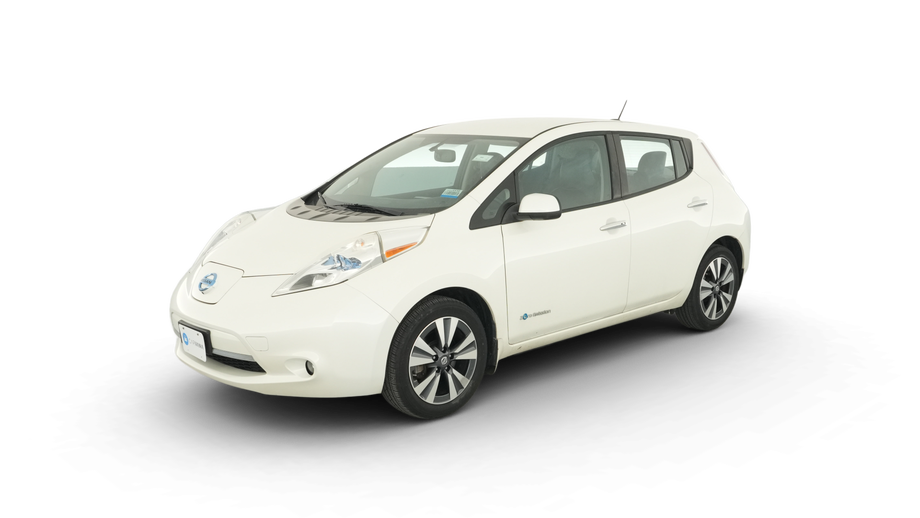
The 2017 Nissan LEAF’s biggest change is that every trim gets the 30-kWh battery and a 107-mile EPA-rated range. Otherwise, it is largely a carryover and the final model year of the first-generation LEAF.
About the 2017 Nissan LEAF
1st generation (2011-2017), final model year before the all-new 2018 redesign.
Nissan positions the LEAF as an everyday electric hatchback that removes gas stops from normal life without asking drivers to relearn how to use a car. Its core appeal is simple, affordable electric driving, quiet operation, instant low-speed response, and easy home or public charging. For most shoppers, the LEAF’s draw is not luxury or performance — it is being a practical five-door commuter and errand car that feels familiar while delivering zero tailpipe emissions.
The S is the straightforward entry trim, with heated front seats, automatic climate control, keyless start, and the same 107-mile range as the upper trims. The SV adds faster charging hardware, navigation, and remote charging and climate functions, while the SL adds leather seating, LED low-beam headlights, fog lights, and a solar-panel rear spoiler.
What changed, by category
Powertrain
The 30-kWh battery becomes standard across the S, SV, and SL lineup, giving every 2017 LEAF an EPA-rated range of 107 miles. The base S no longer uses the shorter-range 24-kWh battery.
2017 Nissan LEAF specs and features by trim
| Feature | |||
|---|---|---|---|
| Engine | AC Electric Motor | AC Electric Motor | AC Electric Motor |
| Transmission | Single-Speed Fixed Gear | Single-Speed Fixed Gear | Single-Speed Fixed Gear |
| Drivetrain | FWD | FWD | FWD |
| Fuel Type | Electric | Electric | Electric |
| Horsepower | 107 hp | 107 hp | 107 hp |
| Torque | 187 lb-ft | 187 lb-ft | 187 lb-ft |
| Trunk/Cargo | 30 cu-ft | 30 cu-ft | 30 cu-ft |
| Rear Legroom | 33.3 in | 33.3 in | 33.3 in |
| Seats | 5 | 5 | 5 |
| Doors | 4 | 4 | 4 |
| Electric Range | 107 | 107 | 107 |
| MPGe Combined | 112 | 112 | 112 |
| Alarm System | |||
| Automatic Headlights | |||
| Rear View Camera | |||
| Alloy Wheels | |||
| Fog Lights | |||
| Heated Mirrors | |||
| LED Headlights | |||
| Rear Spoiler | |||
| Navigation System | |||
| Premium Audio | |||
| Satellite Radio | |||
| Smartphone Interface | |||
| Auto-Dimming Interior Mirror | |||
| Heated Front Seats | |||
| Heated Rear Seats | |||
| Heated Steering Wheel | |||
| Integrated Garage Door Opener | |||
| Leather Seats | |||
| Leather-Wrapped Steering Wheel | |||
| Proximity Keyless Entry | |||
| Push-Button Engine Start | |||
| Tilt Wheel | |||
Frequently asked questions
What changed on the 2017 Nissan LEAF compared with the 2016 model?
The main change is the base S trim’s move to the 30-kWh battery, which gives it the same 107-mile EPA-rated range as the SV and SL. The shorter-range S-24 name becomes S, and S-30 is no longer a separate trim listing.
Does every 2017 Nissan LEAF have the 30-kWh battery?
Yes. Every 2017 LEAF trim—S, SV, and SL—has the 30-kWh battery and a 107-mile EPA-rated range.
Was the 2017 Nissan LEAF redesigned?
No. The 2017 LEAF is largely a carryover and the final model year of the first generation; the full redesign arrived for 2018.
What is the difference between the 2017 LEAF S, SV, and SL?
The S covers the basics, the SV adds faster charging hardware, navigation, and remote EV functions, and the SL adds leather seating, LED low-beam headlights, fog lights, and a solar-panel rear spoiler. All three have the same battery and EPA-rated range.
Is the 2017 Nissan LEAF worth considering over the 2016 model?
The 2017 is most appealing if you are comparing base S trims because it has the larger 30-kWh battery and a 107-mile EPA-rated range. The rest of the first-generation LEAF formula changes very little.
2017 Nissan LEAF Reviews
What owners are saying about the 2017 Nissan LEAF.
4.2
2017 Nissan LEAF
(409 reviews)
“Electric vehicles are a great way to reduce our carbon footprint. They are so much easier to fuel and maintain. I most likely will never buy an internal combustion engine again! Nissan was the first to mass produce an electric vehicle, and I am proud to be an early adopter.”
“You'll need to be mindful of the battery utilization in the winter months as running the heater and the cold temps will drain the battery faster than just driving it during summer months when the temp is above freezing.”