
2026 Chevrolet Blazer EV: What's New, Specs & Features
Last updated August 4, 2026
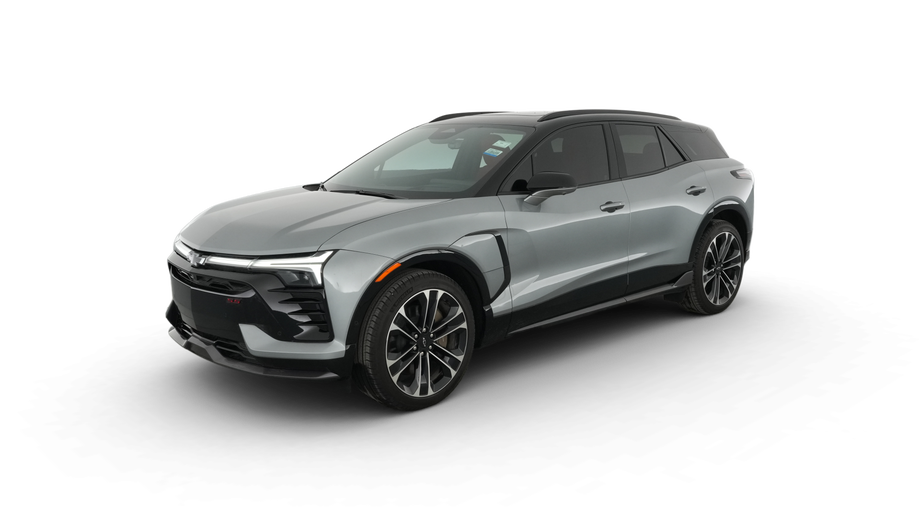
The main change for the 2026 Chevrolet Blazer EV is the removal of the rear-wheel-drive RS. Otherwise, this is a light-update year with no redesign or broad equipment overhaul.
About the 2026 Chevrolet Blazer EV
1st generation (introduced for 2024), third model year, no major refresh.
Chevrolet positions the Blazer EV as a sporty midsize electric SUV that mixes standout styling, useful cargo space, and a big-screen cabin with real everyday range. It is less about bare-bones efficiency and more about giving buyers an EV that looks dramatic, feels familiar as a five-passenger SUV, and scales from a simpler LT to a much quicker SS. The design, 17.7-inch touchscreen, roomy layout, and strong standard safety story are the main through-lines across the range.
The LT is the straightforward everyday version, with an 85-kWh battery, a 17.7-inch touchscreen, an 11-inch driver display, and a broad set of standard safety features. The RS adds a sportier look and comfort touches such as ventilated front seats, while the SS pairs a 102-kWh battery with performance AWD, up to 615 horsepower, and hands-free highway driving.
What changed, by category
2026 Chevrolet Blazer EV specs and features by trim
| Feature | |||
|---|---|---|---|
| Engine | Electric Motor / Dual Electric Motors | Electric Motor / Dual Electric Motors | Dual Electric Performance Motors |
| Transmission | Single-Speed Fixed Gear | Single-Speed Fixed Gear | Single-Speed Fixed Gear |
| Drivetrain | AWD | AWD | AWD |
| Fuel Type | Electric | Electric | Electric |
| Max Towing | 1500 lb | 1500 lb | |
| Trunk/Cargo | 59.1 cu-ft | 59.1 cu-ft | 59.1 cu-ft |
| Rear Legroom | 38.9 in | 38.9 in | 38.9 in |
| Seats | 5 | 5 | 5 |
| Doors | 4 | 4 | 4 |
| Electric Range | 283–312 | 283–312 | 302 |
| MPGe Combined | 94–104 | 94–104 | 85 |
| Adaptive Cruise Control | |||
| Alarm System | |||
| Automatic High Beams | |||
| Blindspot Sensors | |||
| Lane Departure Warning | |||
| Park Assist | |||
| Rain Sensing Windshield Wipers | |||
| 360 Camera | |||
| Alloy Wheels | |||
| Auto-Dimming Exterior Mirrors | |||
| Heated Mirrors | |||
| LED Headlights | |||
| Memory Exterior Mirrors | |||
| Panorama Moon Roof | |||
| Power Folding Exterior Mirrors | |||
| Power Liftgate/Trunk Release | |||
| Roof Rails | |||
| Trailer Hitch Receiver | |||
| Bluetooth | |||
| Satellite Radio | |||
| USB Ports | |||
| Auto-Dimming Interior Mirror | |||
| Chrome Interior Trim | |||
| Dual Power Front Seats | |||
| Dual-Zone Climate Control | |||
| Heated Front Seats | |||
| Heated Rear Seats | |||
| Heated Steering Wheel | |||
| Integrated Garage Door Opener | |||
| Interior Ambient Lighting | |||
| Memory Driver's Seat | |||
| Remote Start | |||
| Ventilated Front Seats | |||
Frequently asked questions
What is the main change to the 2026 Chevrolet Blazer EV?
The main change is the removal of the rear-wheel-drive RS. The remaining lineup centers on front- and all-wheel-drive LT and RS versions, with the SS serving as the dedicated performance model.
Is the 2026 Chevrolet Blazer EV a redesign?
No, the 2026 Blazer EV is not a redesign. It remains part of the first generation introduced for 2024, with the same basic body, cabin layout, and major display hardware.
How does the 2026 Blazer EV RS differ from the 2025 RS?
The 2026 RS no longer has a rear-wheel-drive version. Its electric range spans 283–312 miles, while the 2025 RS range extended as high as 334 miles.
What makes the 2026 Blazer EV SS different from the other trims?
The SS is the performance-focused 2026 Blazer EV. It has performance AWD, up to 615 horsepower and 650 lb-ft of torque, a 102-kWh battery, faster DC charging capability, and hands-free highway driving.
Is the 2026 Blazer EV substantially different from the 2025 model?
No, the 2026 Blazer EV is largely a carryover from 2025. The meaningful change is the loss of the rear-wheel-drive RS; there is no model-wide redesign or major update to the screens, safety suite, chassis, or battery hardware.